OWNINTO | TORONTO HOUSING MARKET SERIES
Part One of Two
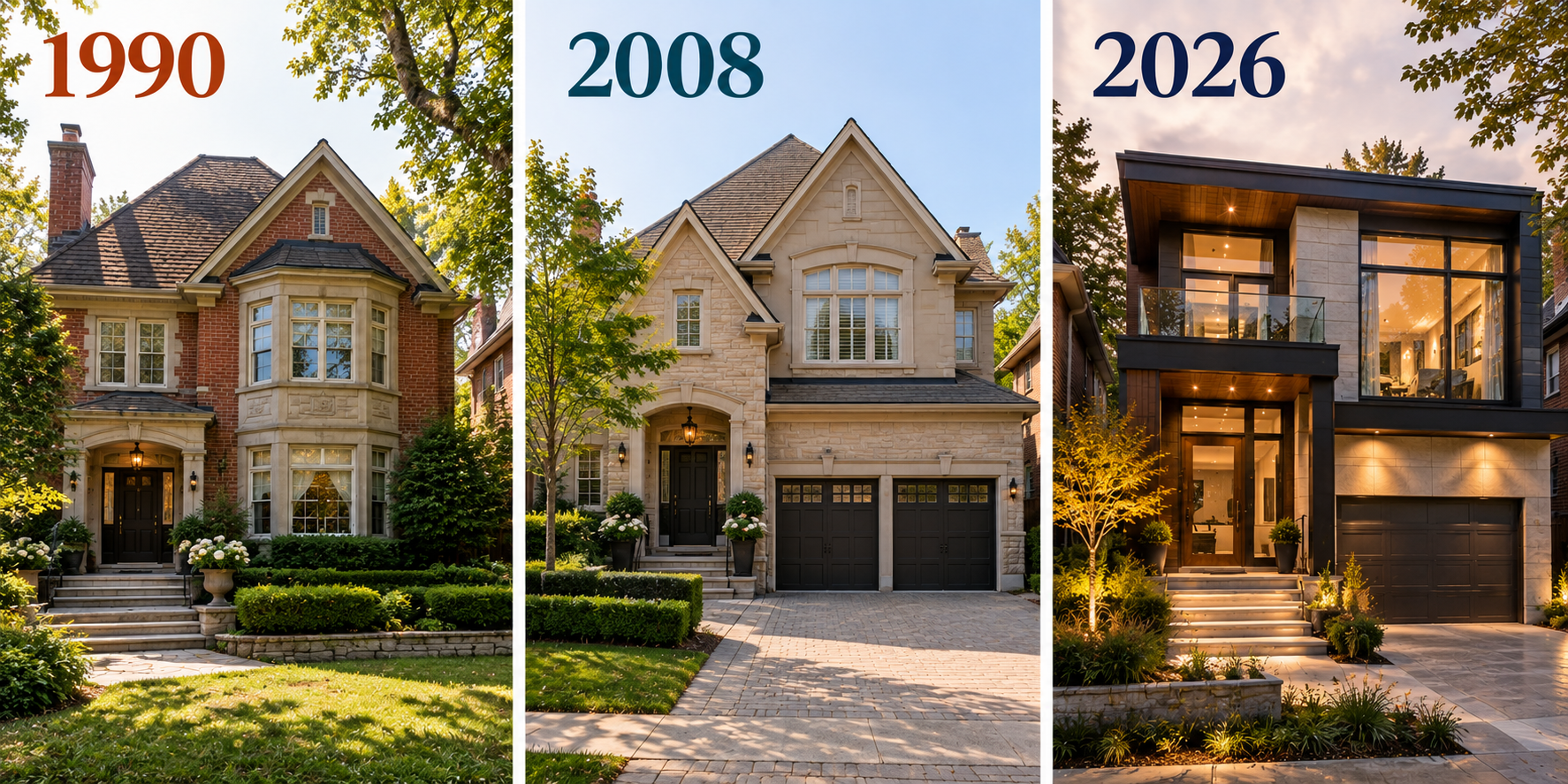
Every time Toronto's real estate market gets uncomfortable, someone brings up 2008. But anyone who owned a home here in the early 1990s might remember a rather different horror story.
Apparently, every difficult housing market needs a historical comparison. And for the past few years, 2008 has been getting quite a workout.
Prices are falling? Remember 2008.
Buyers are nervous? Just like 2008.
The market isn't behaving the way we'd like? Here comes 2008 again.
There's just one problem. If we're talking about Toronto, we may be remembering the wrong housing crash.
The 1990s: Toronto's long hangover
By the late 1980s, Toronto real estate was booming. Prices had climbed dramatically, speculation was widespread, and the assumption that property values would continue rising seemed almost unshakeable.
Then the music stopped.
According to historical Toronto Real Estate Board statistics, the average selling price across its reporting area reached $273,698 in 1989. By 1996, that figure had fallen to $198,317.
That's a decline of approximately 27.5%.
And unlike a brief market correction, this one dragged on for years.
For anyone who experienced Toronto's housing market in the early 1990s, mortgage rates weren't just another economic statistic. They were a very real part of everyday financial decisions.
Mortgage rates approaching 15% were hardly unusual. The Bank of Canada's historical records confirm that five-year conventional mortgage rates reached 14.25% in the spring of 1990.
Imagine trying to carry a mortgage at those rates today.
High borrowing costs were only part of the problem. Ontario entered a serious recession, unemployment rose, and buyers who had stretched to purchase near the peak found themselves in extraordinarily difficult circumstances.
Even as mortgage rates eventually declined, the housing market took years to recover.
Using annual average prices, it wasn't until 2002 that the broader Toronto Real Estate Board market finally exceeded its 1989 price level.
Thirteen years.
That's quite a long time to wait for a market to get back to where it started.
And that's the important lesson of the 1990s. It wasn't simply how far prices fell. It was how long the market remained under pressure.
Then came 2008. Except Toronto didn't follow the script.
The global financial crisis was an economic earthquake.
American banks collapsed, credit markets seized up, and U.S. housing prices suffered a devastating correction.
Naturally, Toronto buyers and sellers were worried.
Sales activity dropped sharply, confidence evaporated, and the local market experienced a pronounced interruption.
But here's the interesting part.
Historical Toronto Real Estate Board records show average selling prices across its reporting area of $378,339 in 2007, $382,512 in 2008, and $397,490 in 2009.
Looking at annual figures alone, you might wonder what all the fuss was about.
The monthly numbers tell a different story.
Average selling prices reached approximately $399,000 in April 2008 before dropping to around $354,000 by October—a decline of roughly 11% between those months.
By June 2009, the average had recovered to approximately $404,000.
A sharp correction, certainly. But nothing resembling the prolonged decline Toronto experienced during the 1990s.
Falling interest rates helped. The Bank of Canada's historical records show five-year conventional mortgage rates dropping from around 7% in late 2008 to approximately 5.25% by April 2009.
Canada's comparatively resilient banking system also helped prevent the kind of financial collapse experienced south of the border.
The American housing crash became the defining image of 2008. Toronto's experience was considerably different.
Fast-forward to 2022: When the pandemic changed what home meant
The pandemic didn't just change mortgage rates. It changed how Torontonians wanted to live.
For many condominium owners, the appeal of compact urban living diminished when home suddenly became the office, gym and virtually everything else.
Shared amenities were restricted, outdoor space became a luxury, and that second bedroom was no longer simply nice to have.
For those who could afford it, the appeal of moving from a condominium into a house—with more room, a backyard and perhaps an actual door to close on the home office—became considerably stronger.
At the same time, borrowing money had become remarkably inexpensive.
In March 2020, the Bank of Canada reduced its overnight policy rate to just 0.25% to support the economy during the pandemic.
By January 2022, average five-year variable mortgage rates were around 1.5%, while five-year fixed rates averaged approximately 2.8%.
Combine exceptionally cheap financing with changing housing priorities and a limited supply of desirable houses, and you have the ingredients for an extraordinary real estate boom.
And extraordinary it was.
Then came inflation.
Supply-chain disruptions, surging demand and rising energy prices pushed inflation sharply higher. The Bank of Canada responded by increasing interest rates aggressively throughout 2022.
By December, its overnight policy rate had risen from 0.25% to 4.25%.
Suddenly, buyers who could comfortably qualify for a mortgage months earlier were facing dramatically different borrowing costs.
The desire for more space hadn't necessarily disappeared. The ability to pay ever-higher prices for it had.
And Toronto's housing market began its correction.
Different roads, but a remarkably similar destination
Here's what makes the comparison with 1990 so interesting.
In the early 1990s, Toronto buyers were dealing with extraordinarily expensive borrowing.
In 2022, buyers were coming off a period of extraordinarily cheap borrowing that had helped propel prices to unprecedented levels.
Different circumstances, but both periods ultimately exposed serious housing affordability problems.
The difference is that today's mortgage rates are nowhere near the levels experienced in 1990.
Yet home prices relative to household incomes have become so high that affordability pressures have approached those of the early 1990s.
Apparently, you don't need a 14% mortgage rate to recreate 1990-level housing affordability. Really expensive houses will do the trick.
Three downturns. Three very different stories.
The problem with the headline housing prices are falling is that it doesn't begin to explain what's actually happening.
The early 1990s: A severe economic downturn, exceptionally high borrowing costs, falling property values and a recovery that took more than a decade.
2008–09: A global financial crisis that disrupted Toronto's market, but from which local prices recovered comparatively quickly.
2022–26: A correction following extraordinary pandemic-era price increases, changing housing preferences and one of the fastest interest-rate tightening cycles in recent history.
And unlike 2008, the current market hasn't simply bounced back after a few uncomfortable quarters.
More than four years after the February 2022 peak, Toronto is still working through the adjustment.
In September 2026, TRREB reported that its MLS Home Price Index composite benchmark was down 4.7% from a year earlier across the GTA. Sales were also down 9%.
Those figures don't mean every Toronto property has declined by the same amount. Far from it.
A detached home in Leaside, a semi in Riverdale and an investment condominium downtown can behave very differently, even during the same economic cycle.
That's why broad market headlines are useful for context, but much less useful when you're making decisions about a particular property.
So what does history tell us?
Perhaps the most important lesson is that housing markets don't operate on a convenient schedule.
Prices don't necessarily recover just because interest rates start falling. Buyers don't immediately return because economists announce that the worst is over.
Sometimes the market needs time.
Time for incomes to catch up. Time for affordability to improve. Time for buyers and sellers to adjust their expectations.
And sometimes the market can be improving beneath the surface long before the headlines become encouraging.
Which brings us to the question that really matters today.
Are we approaching the end of Toronto's current housing correction, or is there still more adjusting to come?
That's where things get particularly interesting.
Coming next — Part Two: Has Toronto's Housing Market Found Its Bottom?
At an October 2026 economic presentation, BMO Chief Economist Douglas Porter offered a fascinating perspective on housing affordability and why a recovery may look quite different from what many buyers and sellers expect.
In Part Two, we'll bring that analysis home to Toronto, looking at mortgage rates, affordability, the differences between houses and condominiums, and what a market finding its footing might actually mean.
Because finding the bottom and starting another housing boom are two very different things.
Toronto's housing market has never been particularly predictable, but understanding its history can help put today's decisions into perspective.
Wondering how these broader trends relate to your own home or neighbourhood? Sometimes a conversation is more useful than another market headline.
OwnInTO | Bosley Real Estate Ltd., Brokerage
Helping Happy People have Happy Homes.