OWNINTO | TORONTO HOUSING MARKET SERIES
Part Two of Two
In Part One, we looked back at three very different housing corrections: Toronto’s long decline through the 1990s, the comparatively brief disruption of 2008 and the adjustment that began after the market peaked in 2022.
The history was interesting. The question facing Toronto buyers and sellers today is considerably more practical:
Has the market finally found its bottom?
The answer depends on what kind of property you are talking about.
A market can stop falling without taking off again
Finding the bottom does not mean that prices suddenly begin climbing, buyers rush back or every listing attracts multiple offers.
It means that the forces pushing the market downward are beginning to lose strength.
Sales stabilize. New listings stop building at the same pace. Prices move sideways instead of continuing to fall. Affordability gradually improves as incomes rise and buyers adjust to the cost of borrowing.
The result can look remarkably uneventful.
That is why a market bottom is usually easier to identify after it has passed. There is rarely a bell, banner or enthusiastic economist standing on the corner announcing that the moment has arrived.
Instead, the market begins finding its footing quietly—and unevenly.
Toronto is not one housing market
Broad statistics are useful, although they can conceal as much as they reveal.
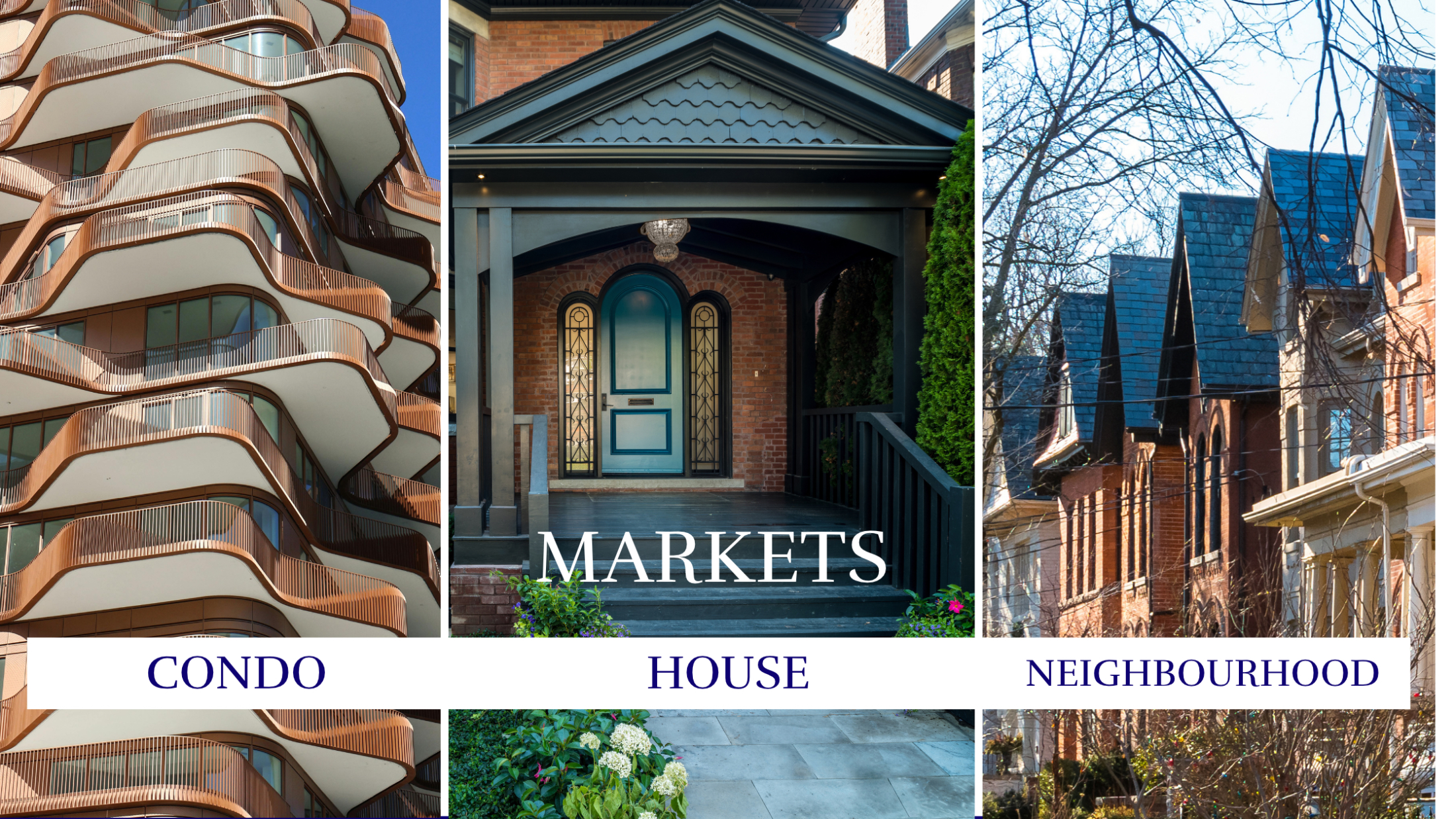
A detached home in an established neighbourhood is not competing with a small investor-owned condominium downtown. Each attracts a different buyer, faces different supply conditions and responds differently to changes in financing.
BMO Economics has identified this divide as one of the defining features of the current correction.
Greater Toronto benchmark prices fell substantially from their February 2022 peak. Yet the next stage may not arrive evenly across every property type.
Quality single-family homes in established neighbourhoods are comparatively scarce. Families who postponed moving have not necessarily stopped needing another bedroom, a yard or a better location. As affordability slowly improves, those buyers may return first.
The condominium market faces a different challenge.
Toronto has a considerable supply of smaller units originally designed and sold with investors in mind. Higher carrying costs, weaker investor demand and an active inventory of resale and newly completed units continue to place pressure on that segment.
One part of the Toronto market can therefore stabilize while another is still working through excess supply.
Affordability has improved—just not enough
Prices have adjusted considerably since 2022. Borrowing costs also came down from their recent highs before the Bank of Canada increased its policy rate by 0.25 percentage points on October 28.
The adjustment has improved the calculation for some buyers, although Toronto housing remains expensive relative to household income.
BMO estimated that mortgage carrying costs for a typical Toronto home had fallen from approximately 68% of median after-tax income at the market peak to about 49%.
That is meaningful progress.
It is still well above the level historically considered comfortable.
This is an important distinction. Toronto may no longer be as dramatically overextended as it was in early 2022, without yet being broadly affordable.
More of the correction may occur through time rather than another sharp decline in prices. Incomes can rise, buyers can save larger deposits and nominal prices can remain relatively flat while affordability slowly improves underneath them.
A market does not always need another crash to complete its adjustment.
The interest-rate path remains uncertain
At an October economic presentation, BMO Chief Economist Douglas Porter made the case that interest rates might remain steady while inflation excluding energy stayed relatively controlled.
Events moved quickly.
On October 28, the Bank of Canada raised its overnight rate to 2.5%, citing persistent inflation pressures associated with higher energy costs and the risk that those costs could spread more broadly through the economy.
The Bank also indicated that housing is expected to remain relatively weak while acknowledging that Canadian economic growth has been more resilient than anticipated.
For buyers, the message is not that another major housing decline is inevitable.
It is that the recovery is unlikely to follow a straight line.
Mortgage rates, employment confidence and the cost of everyday living will continue influencing when buyers feel able—not merely willing—to move forward.
The demand has not disappeared
Years of difficult affordability have delayed household formation and housing decisions across Canada.
Some buyers have remained in rental accommodation longer than intended. Others have postponed moving from a condominium to a house, downsizing from a larger property or establishing a home of their own.
RBC Economics estimates that the formation of more than 400,000 Canadian households may have been suppressed since 2019.
That does not mean 400,000 buyers are waiting with deposits and mortgage approvals in hand.
It does suggest that a significant amount of housing demand has been postponed rather than permanently eliminated.
This distinction matters because markets can appear quiet while potential demand accumulates beneath the surface.
Confidence, financing and affordability will determine how quickly that demand returns.
So, has Toronto found its bottom?
For some established house markets, the answer may be close—or possibly already.
For condominium segments with substantial inventory, the adjustment may continue into 2027.
For Toronto overall, the most reasonable expectation is not another pandemic-style surge. It is a gradual and uneven recovery, with certain neighbourhoods and property types beginning to strengthen well before the broader headlines change.
The next market cycle may look less like a boom and more like a return to normal decision-making.
Buyers will compare properties carefully. Sellers will need to price accurately. Preparation, presentation and local market knowledge will matter.
Frankly, that may be healthier than another round of panic buying, speculative enthusiasm and offers written from the front seat of a car.
What this means for buyers and sellers
Buyers should not interpret a stabilizing market as a reason to rush.
They should use the opportunity to understand their financing, strengthen their deposit and identify the type of property that will support their longer-term plans.
Sellers should not assume that a general market recovery will correct an ambitious asking price.
The strongest results will continue to come from properties that are properly prepared, strategically priced and positioned for the buyers active in that particular neighbourhood.
Toronto’s market may be finding its footing.
Where an individual property stands within that recovery is a much more useful question.
Wondering what these broader shifts mean for your own home, neighbourhood or plans? Sometimes a conversation is more useful than another market headline.
OwnInTO | Bosley Real Estate Ltd., Brokerage
Helping Happy People have Happy Homes.
Sources:
BMO Economics, “Canadian Housing Monitor: May 2026 — The Beautiful Lull,” June 16, 2026.
BMO Economics, “Canada’s Split-level Housing Market”, May 15, 2026.
Bank of Canada, “Bank of Canada raises the policy rate by 25 basis points to 2½%,” October 28, 2026.
RBC Economics, “Mid-year outlook for Canada’s housing market: Between correction and recovery,” September 1, 2026.