RSS

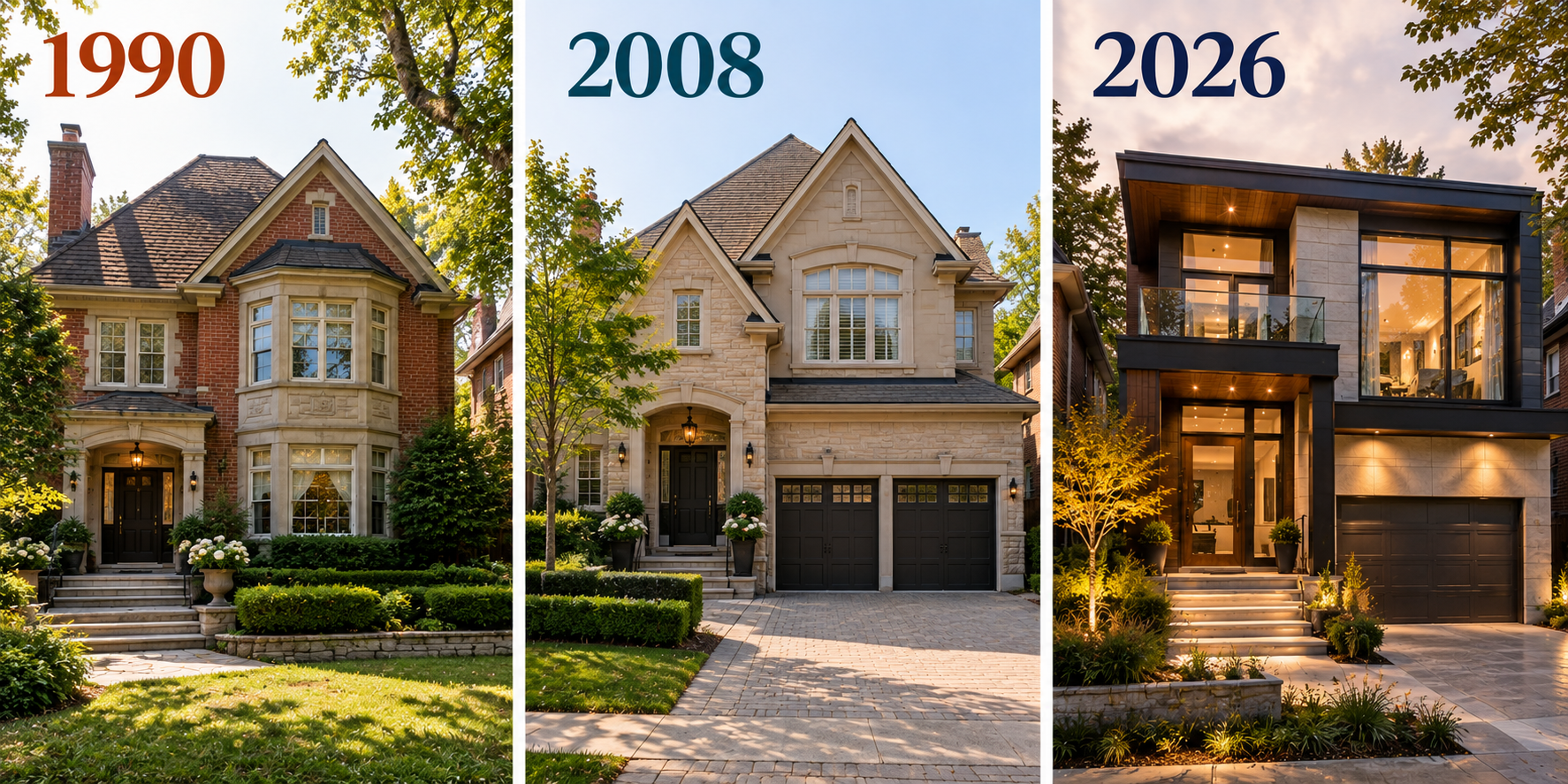
Toronto's Housing Crashes: Why 1990 Matters More Than 2008

OWNINTO | TORONTO HOUSING MARKET SERIES

Part One of Two

Every time Toronto's real estate market gets uncomfortable, someone brings up 2008. But anyone who owned a home here in the early 1990s might remember a rather different horror story.

Apparently, every difficult housing market needs a historical comparison. And for the past few years, 2008 has been getting quite a workout.

Prices are falling? Remember 2008.

Buyers are nervous? Just like 2008.

The market isn't behaving the way we'd like? Here comes 2008 again.

There's just one problem. If we're talking about Toronto, we may be remembering the wrong housing crash.

The 1990s: Toronto's long hangover

By the late 1980s, Toronto real estate was booming. Prices had climbed dramatically, speculation was widespread, and the assumption that property values would continue rising seemed almost unshakeable.

Then the music stopped.

According to historical Toronto Real Estate Board statistics, the average selling price across its reporting area reached $273,698 in 1989. By 1996, that figure had fallen to $198,317.

That's a decline of approximately 27.5%.

And unlike a brief market correction, this one dragged on for years.

For anyone who experienced Toronto's housing market in the early 1990s, mortgage rates weren't just another economic statistic. They were a very real part of everyday financial decisions.

Mortgage rates approaching 15% were hardly unusual. The Bank of Canada's historical records confirm that five-year conventional mortgage rates reached 14.25% in the spring of 1990.

Imagine trying to carry a mortgage at those rates today.

High borrowing costs were only part of the problem. Ontario entered a serious recession, unemployment rose, and buyers who had stretched to purchase near the peak found themselves in extraordinarily difficult circumstances.

Even as mortgage rates eventually declined, the housing market took years to recover.

Using annual average prices, it wasn't until 2002 that the broader Toronto Real Estate Board market finally exceeded its 1989 price level.

Thirteen years.

That's quite a long time to wait for a market to get back to where it started.

And that's the important lesson of the 1990s. It wasn't simply how far prices fell. It was how long the market remained under pressure.

Then came 2008. Except Toronto didn't follow the script.

The global financial crisis was an economic earthquake.

American banks collapsed, credit markets seized up, and U.S. housing prices suffered a devastating correction.

Naturally, Toronto buyers and sellers were worried.

Sales activity dropped sharply, confidence evaporated, and the local market experienced a pronounced interruption.

But here's the interesting part.

Historical Toronto Real Estate Board records show average selling prices across its reporting area of $378,339 in 2007, $382,512 in 2008, and $397,490 in 2009.

Looking at annual figures alone, you might wonder what all the fuss was about.

The monthly numbers tell a different story.

Average selling prices reached approximately $399,000 in April 2008 before dropping to around $354,000 by October—a decline of roughly 11% between those months.

By June 2009, the average had recovered to approximately $404,000.

A sharp correction, certainly. But nothing resembling the prolonged decline Toronto experienced during the 1990s.

Falling interest rates helped. The Bank of Canada's historical records show five-year conventional mortgage rates dropping from around 7% in late 2008 to approximately 5.25% by April 2009.

Canada's comparatively resilient banking system also helped prevent the kind of financial collapse experienced south of the border.

The American housing crash became the defining image of 2008. Toronto's experience was considerably different.

Fast-forward to 2022: When the pandemic changed what home meant

The pandemic didn't just change mortgage rates. It changed how Torontonians wanted to live.

For many condominium owners, the appeal of compact urban living diminished when home suddenly became the office, gym and virtually everything else.

Shared amenities were restricted, outdoor space became a luxury, and that second bedroom was no longer simply nice to have.

For those who could afford it, the appeal of moving from a condominium into a house—with more room, a backyard and perhaps an actual door to close on the home office—became considerably stronger.

At the same time, borrowing money had become remarkably inexpensive.

In March 2020, the Bank of Canada reduced its overnight policy rate to just 0.25% to support the economy during the pandemic.

By January 2022, average five-year variable mortgage rates were around 1.5%, while five-year fixed rates averaged approximately 2.8%.

Combine exceptionally cheap financing with changing housing priorities and a limited supply of desirable houses, and you have the ingredients for an extraordinary real estate boom.

And extraordinary it was.

Then came inflation.

Supply-chain disruptions, surging demand and rising energy prices pushed inflation sharply higher. The Bank of Canada responded by increasing interest rates aggressively throughout 2022.

By December, its overnight policy rate had risen from 0.25% to 4.25%.

Suddenly, buyers who could comfortably qualify for a mortgage months earlier were facing dramatically different borrowing costs.

The desire for more space hadn't necessarily disappeared. The ability to pay ever-higher prices for it had.

And Toronto's housing market began its correction.

Different roads, but a remarkably similar destination

Here's what makes the comparison with 1990 so interesting.

In the early 1990s, Toronto buyers were dealing with extraordinarily expensive borrowing.

In 2022, buyers were coming off a period of extraordinarily cheap borrowing that had helped propel prices to unprecedented levels.

Different circumstances, but both periods ultimately exposed serious housing affordability problems.

The difference is that today's mortgage rates are nowhere near the levels experienced in 1990.

Yet home prices relative to household incomes have become so high that affordability pressures have approached those of the early 1990s.

Apparently, you don't need a 14% mortgage rate to recreate 1990-level housing affordability. Really expensive houses will do the trick.

Three downturns. Three very different stories.

The problem with the headline housing prices are falling is that it doesn't begin to explain what's actually happening.

The early 1990s: A severe economic downturn, exceptionally high borrowing costs, falling property values and a recovery that took more than a decade.

2008–09: A global financial crisis that disrupted Toronto's market, but from which local prices recovered comparatively quickly.

2022–26: A correction following extraordinary pandemic-era price increases, changing housing preferences and one of the fastest interest-rate tightening cycles in recent history.

And unlike 2008, the current market hasn't simply bounced back after a few uncomfortable quarters.

More than four years after the February 2022 peak, Toronto is still working through the adjustment.

In September 2026, TRREB reported that its MLS Home Price Index composite benchmark was down 4.7% from a year earlier across the GTA. Sales were also down 9%.

Those figures don't mean every Toronto property has declined by the same amount. Far from it.

A detached home in Leaside, a semi in Riverdale and an investment condominium downtown can behave very differently, even during the same economic cycle.

That's why broad market headlines are useful for context, but much less useful when you're making decisions about a particular property.

So what does history tell us?

Perhaps the most important lesson is that housing markets don't operate on a convenient schedule.

Prices don't necessarily recover just because interest rates start falling. Buyers don't immediately return because economists announce that the worst is over.

Sometimes the market needs time.

Time for incomes to catch up. Time for affordability to improve. Time for buyers and sellers to adjust their expectations.

And sometimes the market can be improving beneath the surface long before the headlines become encouraging.

Which brings us to the question that really matters today.

Are we approaching the end of Toronto's current housing correction, or is there still more adjusting to come?

That's where things get particularly interesting.

Coming next — Part Two: Has Toronto's Housing Market Found Its Bottom?

At an October 2026 economic presentation, BMO Chief Economist Douglas Porter offered a fascinating perspective on housing affordability and why a recovery may look quite different from what many buyers and sellers expect.

In Part Two, we'll bring that analysis home to Toronto, looking at mortgage rates, affordability, the differences between houses and condominiums, and what a market finding its footing might actually mean.

Because finding the bottom and starting another housing boom are two very different things.

Toronto's housing market has never been particularly predictable, but understanding its history can help put today's decisions into perspective.

Wondering how these broader trends relate to your own home or neighbourhood? Sometimes a conversation is more useful than another market headline.

OwnInTO | Bosley Real Estate Ltd., Brokerage
Helping Happy People have Happy Homes.

Read

The Bank Is Holding. Why Are Mortgage Rates Moving?

The Bank of Canada held its overnight rate at 2.25% on September 2. Prime stayed at 4.45%. It was the Bank’s seventh consecutive rate hold.

Seven holds. Nothing to see here.

Except, of course, mortgage rates can still move.

This is one of those wonderfully Canadian financial arrangements in which the rate-setting bank does nothing, bond markets do something and homeowners are left wondering why the mortgage they looked at last month costs more today.

Jason Friesen, Partner and Mortgage Agent with Outline Financial, recently shared the firm’s September Mortgage & Economic Outline. It helps explain how the Bank of Canada can hold its rate steady while mortgage rates—and the monthly cost of carrying one—continue doing something else entirely.

Two kinds of mortgage rates. Two different rule books.

Variable mortgage rates generally follow the Bank of Canada’s policy rate. When the Bank changes its overnight rate, lenders typically change their prime rates.

Fixed mortgage rates are different. They are influenced primarily by Government of Canada bond yields, which can move every day in response to inflation, economic reports, oil prices, trade disputes and international events.

So while everyone is waiting for the Bank of Canada to make an announcement, the bond market may already have left the building.

According to Outline Financial, the five-year Government of Canada bond yield increased from 2.67% on February 27 to 3.63% on September 10. That is a rise of 96 basis points.

Fixed mortgage rates do not necessarily move by the same amount, but bond yields are an important signal of where they may be heading.

The practical point is simple: waiting for the next Bank of Canada announcement does not guarantee that today’s fixed mortgage rate will still be available tomorrow.

The economy is sending mixed messages

If you are hoping the economic data will provide a clear answer about what happens next, you may want to sit down.

Canada’s economy grew at an annualized rate of 3.3% during the second quarter of 2026. That was stronger than the Bank of Canada had forecast and eliminated earlier talk of a technical recession.

Good news.

Canada then lost approximately 41,700 jobs in August, with most of those losses in full-time employment.

Less good news.

The national unemployment rate remained at 6.4%, largely because the labour force also became smaller. Ontario’s unemployment rate edged up from 6.8% to 6.9%.

Inflation reached 3.0% in July, but much of that increase came from gasoline prices. Remove gasoline and inflation was 2.2%.

To summarize: economic growth was stronger, employment weakened, unemployment barely moved and inflation was high—unless you removed the particularly expensive thing everyone noticed becoming more expensive.

This is why the Bank of Canada keeps using words such as “uncertainty.” It is the central-banking equivalent of saying, “We’ll have to see.”

What are borrowers doing?

An increasing number of borrowers have been choosing variable-rate mortgages.

Bank of Canada data cited by Outline Financial show that variable mortgages accounted for 35.8% of mortgage originations in June, up from 28.5% in March.

This does not mean that 35.8% of borrowers know something the rest of us do not.

A variable mortgage may allow a borrower to benefit if rates eventually fall. It also exposes that borrower to higher payments or increased interest costs if rates rise.

A fixed mortgage provides greater predictability, but the borrower may be locking in after bond yields have already moved higher.

The best mortgage is not necessarily the one attached to the most confident interest-rate prediction. It is the one that still works if the prediction is wrong.

Income stability, future plans, tolerance for changing payments and the possibility of moving or refinancing all matter.

What does this mean for Toronto buyers?

A Bank of Canada rate hold is not a signal that buyers can stop paying attention to financing.

A mortgage pre-approval helps establish a realistic price range. A rate hold may also provide some protection if fixed rates increase while you are looking for a property.

The lender may approve a particular amount, but that does not mean you must spend it. There is a noticeable difference between qualifying for a payment and enjoying the lifestyle that remains after making it.

Buyers should look at the full cost of ownership: mortgage payments, property taxes, maintenance, utilities and—in the case of a condominium—monthly fees and the financial health of the corporation.

The Toronto market also refuses to behave like one unified market. A well-prepared house in a sought-after neighbourhood can attract considerable attention while another property, only a short distance away, sits.

The economic headlines provide context. They do not determine the value of an individual property.

What does this mean for sellers?

Interest rates affect how much buyers can borrow, but they also influence how buyers feel.

Even when buyers can afford a property, uncertainty may make them more selective. They compare condition, location, carrying costs and future work more carefully.

This is not necessarily a bad market for sellers. It is an unforgiving market for properties that are poorly positioned.

Preparation, timing, presentation and price need to work together. Buyers may still act quickly when a property offers the right combination of value and opportunity. They are less likely to overlook an ambitious price simply because the seller would prefer that they did.

So, should you buy, sell or wait?

There is no single economic statistic capable of answering that question.

Rates may rise. They may hold. Economic conditions may strengthen in one area and weaken in another. Bond markets may react to events taking place thousands of kilometres away before the Bank of Canada has issued its next carefully worded statement.

Waiting is still a decision, and it has its own costs and risks.

A better question is whether a move makes sense for your life, your finances and the part of Toronto in which you intend to buy or sell.

Once that is clear, we can build a strategy that does not depend on correctly predicting every move made by the Bank of Canada, the bond market or anyone else with a chart.

If you are considering buying or selling in Toronto, I can help you understand what is happening in the neighbourhood and property category that matter to you. A qualified mortgage professional can then help determine which financing structure best fits your circumstances.

Because “rates are holding” may be technically correct.

It just doesn’t mean nothing is moving.

Economic and mortgage information is based on the September 2026 Mortgage & Economic Outline prepared by Jason Friesen, Managing Partner and Mortgage Agent Level 2 with Outline Financial. Market probabilities and interest rates can change quickly. Mortgage advice should be obtained from a qualified mortgage professional.

Read

The Resilience to High Rates

The final group of borrowers who secured ultra-low mortgage rates during the pandemic is beginning to renew, and 38% of Canadians with a mortgage on their primary residence expect their payments to increase. In Toronto, that figure rises slightly to 39%.

While higher monthly payments will place additional pressure on household budgets, most homeowners are not anticipating a change in where or how they live. Seventy-one per cent of those approaching renewal say they do not plan to move, rent out their home or downsize. Instead, many expect to reduce discretionary spending, travel less or postpone renovations. For most homeowners, higher carrying costs are prompting financial adjustments rather than an immediate change in housing. Home remains a priority, even when maintaining it requires compromises elsewhere in the household budget.

The impact of higher borrowing costs, however, extends beyond the mortgage payment itself. Postponed renovations, reduced discretionary spending and changing monthly obligations can influence when a homeowner chooses to move, how much a buyer can comfortably afford and how existing home equity factors into longer-term plans.

For buyers, this makes understanding the financial picture before beginning a search increasingly important. Purchase price is only one part of that equation. Mortgage structure, monthly carrying costs and future financial flexibility all contribute to determining what is both affordable and sustainable.

For homeowners approaching a renewal, it can also be an appropriate time to consider the larger picture. Understanding the current value of the property, the equity that has been built and how well the home continues to suit future plans can provide useful context before making longer-term financial decisions.

Despite earlier concerns that pandemic-era mortgage renewals could result in a significant increase in defaults, serious mortgage delinquency remains relatively low. Canada’s 90+ day delinquency rate was 0.24% in the fourth quarter of 2025, remaining below pre-pandemic levels.

The numbers suggest that Canadian homeowners are adapting to a different borrowing environment. Higher mortgage payments are undoubtedly changing household finances, but for many, the response is not necessarily to change homes. It is to reassess priorities, understand their financial position and make more deliberate decisions about what comes next.

Read

May Market Snapshot

Across Central Toronto, the market feels different today than it did six months ago.

Buyers are showing up. Properties are receiving attention. Offer dates are returning. Multiple offers are no longer uncommon in the city's prime neighbourhoods.

While we are not experiencing the frenzied conditions of past market cycles, we are seeing something equally important: confidence returning to the marketplace.

The question is no longer whether the market is improving.

The question is how much momentum it can build.

What began as cautious buyer interest earlier this year is evolving into measurable activity across many segments of Toronto's housing market.

While much of the conversation continues to focus on prices that remain below last year's levels, a different story is unfolding beneath the surface. Buyers are returning, sales are increasing, yet fewer homeowners are choosing to list their properties.

That imbalance matters because markets rarely change all at once. Momentum builds gradually. Buyers gain confidence, inventory is absorbed, competition re-emerges, and pricing begins to respond. While we are still in the early stages of that cycle, the underlying trends point to a market that is steadily strengthening.

If you only looked at Toronto's average home prices, you might conclude that very little has changed over the past year. The average home sold for $1,108,292 in May, down 4.1 per cent from a year ago. Condominium values also remain below last spring's levels.

Yet focusing solely on prices misses the bigger picture.

Toronto recorded 2,377 sales in May, an increase of 2.7 per cent compared to last year. At the same time, the number of new listings coming to market fell by 19 per cent. Homes are also selling more quickly, with average days on market declining from 29 days to 26 days while some neighbourhoods are seeing single digit days on market.

Signs of strengthening demand are beginning to appear in the pricing data as well. The average sale price in Toronto increased 1.5 per cent compared to April, while condominium prices rose 1.3 per cent month over month.

Beyond the statistics, we are seeing a noticeable shift in buyer behaviour across many of Toronto's most desirable neighbourhoods. Offer dates, which largely disappeared during the market slowdown, are becoming increasingly common once again. Multiple-offer situations are returning for well-presented homes in sought-after areas, particularly where inventory remains limited.

Buyers remain thoughtful and disciplined in their approach. The urgency and emotion of the pandemic market has not returned, nor should it. Today's buyers are informed, cautious and value conscious. However, they are no longer standing on the sidelines. When the right property comes to market and is priced appropriately, they are prepared to act.

For sellers, this is an encouraging development. A growing pool of active buyers combined with fewer new listings is creating more favourable conditions for well-positioned homes.

Across Central Toronto, the market feels different today than it did six months ago. Buyers are showing up. Properties are receiving attention. Offer dates are returning. Multiple offers are no longer uncommon in the city's prime neighbourhoods.

While we are not experiencing the frenzied conditions of past market cycles, we are seeing something equally important: confidence returning to the marketplace.

Momentum is building. The months ahead will determine just how far it carries the market.

Read

I have sold a property at 120 Rockford Road in Toronto

I have sold a property at 120 Rockford Road in Toronto on Dec 23, 2025. See details here

Rock solid on Rockford. The name says it all - this home is ready to be the setting for your family's next chapter. Nestled in the desirable Westminster-Branson neighbourhood, this surprisingly spacious 4-bedroom, 4-bathroom home offers a functional layout designed for comfortable everyday living and effortless entertaining. From the moment you step inside, you'll appreciate the sense of space and light throughout. The updated kitchen is both stylish and practical, featuring quality finishes and ample storage. Large principal rooms provide flexibility to entertain all of your favourite relatives and family. The fourth bedroom is ideal for a full-time home office, or quiet retreat. Want to catch your favourite sports team on the big screen? Or maybe you'd prefer some more family space? This home has got you covered! There's a ground floor family room, plus two more levels of family space that could become a kid zone, home gym, movie room or dream board games zone. The benefit of two updated full bathrooms and two half bathrooms offer convenience for busy family mornings or when entertaining guests. The two-car garage offers generous storage, while the property provides two separate outdoor spaces with a fenced yard perfect for the kids will the other lets you garden in peace or simply relax. With solid construction and timeless design, this home offers the perfect foundation to add your own personality and create lasting memories for years to come. Enjoy the convenient location close to shopping, schools, and public transit, with easy access to nearby ravine trails - ideal for dog walking or peaceful weekend strolls. Residents love the active, family-friendly community and the strong sense of connection that defines the area. Whether you're growing your family or simply seeking more space, this home delivers comfort, functionality, and lasting value. A true opportunity to put down roots in one of Toronto's most welcoming neighbourhoods.

Read

New property listed in Toronto C07

I have listed a new property at 120 Rockford Road in Toronto. See details here

Rock solid on Rockford. The name says it all - this home is ready to be the setting for your family's next chapter. Nestled in the desirable Westminster-Branson neighbourhood, this surprisingly spacious 4-bedroom, 4-bathroom home offers a functional layout designed for comfortable everyday living and effortless entertaining. From the moment you step inside, you'll appreciate the sense of space and light throughout. The updated kitchen is both stylish and practical, featuring quality finishes and ample storage. Large principal rooms provide flexibility to entertain all of your favourite relatives and family. The fourth bedroom is ideal for a full-time home office, or quiet retreat. Want to catch your favourite sports team on the big screen? Or maybe you'd prefer some more family space? This home has got you covered! There's a ground floor family room, plus two more levels of family space that could become a kid zone, home gym, movie room or dream board games zone. The benefit of two updated full bathrooms and two half bathrooms offer convenience for busy family mornings or when entertaining guests. The two-car garage offers generous storage, while the property provides two separate outdoor spaces with a fenced yard perfect for the kids will the other lets you garden in peace or simply relax. With solid construction and timeless design, this home offers the perfect foundation to add your own personality and create lasting memories for years to come. Enjoy the convenient location close to shopping, schools, and public transit, with easy access to nearby ravine trails - ideal for dog walking or peaceful weekend strolls. Residents love the active, family-friendly community and the strong sense of connection that defines the area. Whether you're growing your family or simply seeking more space, this home delivers comfort, functionality, and lasting value. A true opportunity to put down roots in one of Toronto's most welcoming neighbourhoods.

Read

 “The Toronto Market is in Transition - Smart moves happen to those who see the opportunity”

Dear Toronto,

Here’s a curated breakdown of where we stand:

🏡 DETACHED HOMES Sales: 3,689
Average Price: $1,691,294
Sale Price/List Price: 101%
Average Days on Market: 23
New Listings: 10,697

Takeaway: Detached homes remain the cornerstone of Toronto real estate. While the tempo has slowed slightly, pricing has held firm. The abundance of listings gives buyers leverage — but prime, well-prepared homes still command strong results. Presentation and strategy matter more than ever.

🏘 SEMI-DETACHED Sales: 1,328
Average Price: $1,279,516
Sale Price/List Price: 106%
Average Days on Market: 19
New Listings: 2,913

Takeaway: This segment is outperforming. Demand for semis — particularly in established, walkable neighbourhoods — remains robust. Most are selling well over asking, often in multiple offers. For sellers, the first half of 2025 was fertile ground.

🏙 CONDO APARTMENTS Sales: 5,422
Average Price: $715,378
Sale Price/List Price: 98%
Average Days on Market: 35
New Listings: 20,785

Takeaway: The condo market is experiencing recalibration. With a flood of inventory and a cautious buyer pool,expectations have been reset. That said, quality product — especially those with efficient layouts, outdoor space, and parking — is still moving. For investors and end-users alike, the long-term value proposition remains.

🏡 TOWNHOMES (FREEHOLD + CONDO)
Attached/Row: Avg $1.26M | Sale Price/List Price: 103%
Condo Towns: Avg $839,939 | Sale Price/List Price: 100%

Takeaway: Toronto townhomes continue to appeal to discerning buyers seeking function, style, and a foot on the freehold ladder. These homes are holding their own in both pace and price. Thoughtful updates and good bones are rewarded.

🧾 NICHE MARKETS (CO-OPS, LINK, CO-OWNERSHIP, ETC.)
A quieter corner of the market. While volume remains low - 44 sales for Co-ops and 18 units for CoOwnership , these alternative forms of ownership offer creative entry points — and savvy buyers are taking note.

🔍 THE INTERPRETATION This isn’t a buyer’s market — but it’s not a seller’s market either. We’re in the midst of a strategic market.

FOR BUYERS - Patience and precision are key. The right home is out there, often with room to negotiate.

FOR SELLERS - Success lies in the details. Pricing smartly and preparing thoroughly are the differentiators in this climate.

FOR INVESTORS - Opportunities are re-emerging, particularly in the condo sector, where pricing has softened and yields are improving.

✨ FINAL WORD Toronto’s market is evolving, not unraveling. The fundamentals remain sound: population growth, limited land, and global desirability. As always, those who move with insight — not impulse — are best positioned to benefit for this opportunity.

Curious how this plays out for your property, your investment, or your next move?
Let’s connect. Strategic advice. Zero pressure.

Read

How Much Money Do They Need?

Almost half (47 per cent) of first-time buyers who made a home purchase in the last 18 months were aged between 25 and 34, according to the Canada Mortgage and Housing Corporation’s (CMHC) 2025 mortgage consumer survey.

Where a buyer lives can also influence their age. In the Prairies, most new buyers fell within the 18 to 34 age range, while in regions like Atlantic Canada and British Columbia, first-time buyers tended to be slightly older, CMHC noted.

Leah Zlatkin, mortgage broker and chief operations officer at Mortgage Outlet Inc. in Concord, Ont., says that in the Greater Toronto Area, first-time buyers are typically older than their counterparts in the Greater Horseshoe Area or the Prairie provinces.

“Many of the buyers I work with are in their late twenties to mid-thirties,” Zlatkin said. “Though from time to time, I do assist younger clients—often with help from their parents.”

She attributes this trend to the higher housing costs in the GTA. “People generally need more time to save, especially if they’re aiming for a larger home that suits a growing family,” she added.

Although the 25–34 age group has consistently led since 2019—reaching a high of 56 per cent in both 2023 and 2024—it dropped modestly in 2025, per CMHC findings. The demographic is shifting upward: buyers over 35 made up 39 per cent of the market in 2025, up from 33 per cent in 2024 and 30 per cent the year before.

According to Statistics Canada, the median age of those claiming the first-time home buyer tax credit was 32 in 2022—the most recent year available—up from 30 ten years earlier.

Still, some Canadian cities are managing to attract younger buyers, particularly where housing prices are more accessible.

Montreal offers the best value across Canada where a lot of young people are moving here from other provinces, since they can buy a condo for $500 per square foot instead of $1,000 like in Toronto. 

Screenshot 2025-06-13 131647.png

How much income does a first-time homebuyer need?

The income levels of first-time homebuyers have risen in recent years, crossing into six-figure territory: CMHC reports that in 2025, the median income was around $105,000 — a jump from the $60,000 to $90,000 range noted five years prior.

As per the Canadian Real Estate Association (CREA), the national average home price stood at $707,380 in April. In Ontario and British Columbia, averages neared $1 million, while in Atlantic Canada and in provinces like Saskatchewan and Manitoba, prices ranged between $300,000 and $400,000.

CMHC also found that 71 per cent of first-time homebuyers were married or in common-law relationships, and 91 per cent had jobs.

More than half of these buyers had children in their households, and 64 per cent were renters prior to buying, with an average renting period of 6.3 years.

A growing number of single women in their thirties or early forties are entering the housing market, often purchasing solo — a sign of increasing financial independence and less emphasis on waiting for a partner.

CMHC’s findings also show that 54 per cent of first-time buyers bought a home with another adult who was not their spouse or partner. This trend was most prominent among younger adults aged 18 to 24 and was especially common in Quebec.  

How are first-time buyers putting together their down payment?

According to CMHC, key sources for down payments included 39 per cent from non-RRSP savings, and 38 per cent from first home savings accounts (FHSAs). 

But the most common contribution came in the form of gifts: more than 40 per cent of first-time buyers received financial gifts to assist with their purchase, with the typical gift totaling $74,570.

Gift reliance varied by region — those in higher-cost provinces like Ontario and B.C. were more apt to receive such support, while those in the Prairies were more reliant on their own savings.

Gift amounts ranged widely — from $43,086 in the Prairie provinces to as high as $142,812 in British Columbia. As real estate values outpace wages, parents are increasingly stepping in to close the gap.

CMHC also highlighted a notable jump in the number of buyers who lived with family or friends before purchasing — 35 per cent in the current year, compared to 28 per cent the year before. It’s likely this choice reflects efforts to cut expenses and boost savings in preparation for a home purchase.

Parental help also influences the timeline to save for a down payment. CMHC reports that first-time buyers typically saved for 3.7 years — but without family assistance, it often takes five to seven years, especially in expensive markets like Vancouver. 

How I Help First-Time Buyers Plan for Success

Buying your first home is exciting—but it can also feel overwhelming. With high prices, complex financing, and a lot of opinions from well-meaning friends and family, it’s easy to lose focus. That’s where we come in.

We work closely with first-time buyers to make the process clear, manageable, and rewarding—whether you’re buying solo, with a partner, or even with a friend or family member.

Here’s how we can help you plan with confidence:

1. Understand What You Can Afford—Now and Later
We will help you see the full picture: not just your budget for the home, but the other costs that come with it—like legal fees, land transfer tax, closing costs, and more. We’ll build a realistic plan based on your finances and your goals.

2. Introduce You to Mortgage Experts You Can Trust
We have strong relationships with mortgage advisors who specialize in helping first-time buyers navigate things like RRSP withdrawals, the FHSA, and family gifting. We’ll make sure your financing plan works for you today and supports your future plans.

3. Match Your Lifestyle with the Right Property
Whether you’re planning for kids, buying with a friend, or looking for flexibility down the road, we’ll help you choose a home that fits your life—not just your budget. We’ll also highlight areas where your money goes further or where values are poised to grow.

4. Spot Value in a Competitive Market
With my background in building structure, design, and market history, I’ll help you see the potential in homes others overlook—and know when to walk away from something that’s not worth your money.

5. Make a Strong Offer Without Overpaying
Offers don’t have to be all-or-nothing. We will help you make a smart, competitive offer with the right protections in place, so you’re not overextending or missing something important.

6. Keep You Grounded and Empowered
Buying your first home can stir up a lot—stress, doubt, excitement. We are here to give you clarity, keep things moving, and make sure you feel informed at every step. You don’t have to navigate this alone.

7. Be Your Go-To Resource Beyond Closing Day
Our relationship doesn’t end when you get the keys. We are here to support you through renovations, homeownership questions, and even your next move when the time comes.

The Bottom Line:
Whether you’re saving for your down payment, wondering if you’re ready, or trying to make sense of Toronto’s market, We are here to help. From strategy to celebration, we are in your corner every step of the way. Let's make a smart plan—and find the home that's right for you.

Read

I have sold a property at #606 160 Vanderhoof Avenue in Toronto

I have sold a property at #606 160 Vanderhoof Avenue in Toronto on Sep 30, 2022. See details here

Relish Life In This Warm And Sunny 2 Bdrm-2 Bath With Its Southern City Views. The Spacious Split-Plan Is Ideal For Entertaining, Creating Gourmet Meals Or Working At Home. The Large, Private Balcony Oasis Is Perfect For Morning Yoga And Evening Cocktails With Sunsets. Sleep Soundly In Your Principal Bedroom With Its King Sized Bed And Large Dresser Too! Enjoy Living Next To 32Km Of Energizing Trails, Nature & Parkland. Lrt At Your Door(Coming Soon).

Read

I have sold a property at 36 Ravenscroft Circle in Toronto

I have sold a property at 36 Ravenscroft Circle in Toronto on Mar 14, 2025. See details here

Circle Around To This Fabulous Family Home In A Quiet Enclave Of Bayview Village. Enjoy The Benefits Of Living In An Established Executive Neighbourhood With Access To The Boutique Shops Of Bayview Village, And Top Rated Education Including Earl Haig's Claude Watson Program. Walk Or Ride The Pathways Through The East Don Parklands And Connect To Nature. Play Tennis At The Nearby Tennis Club Or Join A Fitness Class At The Ymca. Convenient Access To Subway.

Read

I have sold a property at 303 600 Eglinton Avenue E in Toronto

I have sold a property at 303 600 Eglinton Avenue E in Toronto on Mar 14, 2025. See details here

Golden Opportunity To Live At Bayview & Egl. You Will Be Overjoyed With This Move In Ready, Open Concept Living. Enjoy Entertaining In The Bright Kitchen With Full Size Appliances, And Quartz Counters. Complete The Buyer Wants List With An Elegant Bathroom Finished In Marble Tile And Ensuite Laundry. With Next Door Access To The Metro, And An 88 Walk Score To The Leaside Shops, Parks And Soon To Be Lrt. There Is No Need For A Car.

Read

I have sold a property at 348 Woodsworth Road in Toronto

I have sold a property at 348 Woodsworth Road in Toronto on Nov 8, 2023. See details here

Nestled in an established executive neighborhood, this home is a versatile gem that offers endless possibilities. Whether you're looking for a spacious family home, a next-stage-of-living retreat, a downsizing haven, or an investment opportunity, this property has you covered. Currently, it's incredibly livable, boasting a serene backdrop as it backs onto a lush ravine with a quintessential babbling brook. But what truly sets this home apart is its potential for transformation. With numerous opportunities for renovation, you can easily turn it into your dream residence. This is the ultimate entry-level property, where you can experience the best of both worlds: a comfortable living space now and the canvas for your future vision.

Read
This website may only be used by consumers that have a bona fide interest in the purchase, sale, or lease of real estate of the type being offered via the website. The data relating to real estate on this website comes in part from the MLS® Reciprocity program of the PropTx MLS®. The data is deemed reliable but is not guaranteed to be accurate.